
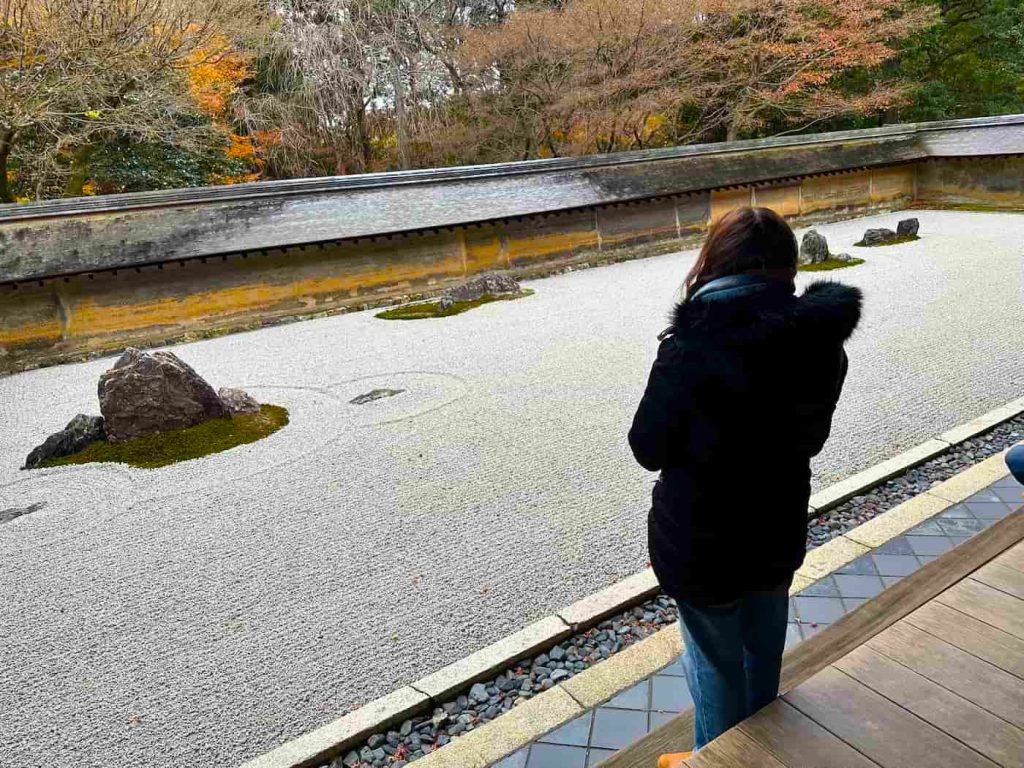
I am standing in the garden of Ryōan-ji on a Tuesday morning in December, and there are just other two people here. It is cold enough that my breath shows, and the light is a flat winter grey, and the fifteen stones are arranged in raked gravel before me but I can’t grasp it all. That is, I think, the point. The arrangement of stones at Ryoan-ji is constructed so that not all fifteen stones can be seen at once from any single vantage point. No matter where I sit or stand, one is always obscured. The composition resists total comprehension, and in doing so, it interrupts the habitual impulse to recognise, to conclude, to name. This type of Japanese garden (Karesansui) replaces directed thinking with a kind of suspended awareness, where perception and cognition are no longer clearly separated.
How Japanese gardens think
Every Japanese garden, regardless of its type or period, is organised by two master principles: scaled reduction and symbolisation. Scaled reduction means taking a landscape, a mountain, a river, a seascape, and representing it in miniature. For example, a boulder represents a mountain, a stream of raked gravel represents a river, a pond represents the sea. This is not mere decoration; it is a cosmological claim: that the essential nature of a landscape can be captured in a compressed form.
Symbolisation means that every element in the garden carries meaning beyond its appearance. Stones represent islands, mountains, or sleeping animals. Mosses represent distance or cloud. The path through the garden represents a journey, through life, through difficulty, toward enlightenment.
- Water represents time, purity, and the flow of existence.
- Yohaku-no-bi is the deliberate use of emptiness as a positive compositional element.
- Miegakure is the principle of strategic concealment, the path is bent and the view is screened so that the visitor never sees everything at once; each turn reveals something new.
- Wabi and Sabi are linked to the aesthetic of imperfection, incompleteness, and age. A garden is not designed to look new but to look old, to have the quality of a place that has always been here. The moss, the lichen on the stone, the leaning lantern are all cultivated qualities.
- Shakkei means borrowed scenery, the compositional device of incorporating distant landscape elements, a mountain, a grove of trees, a distant temple into the garden’s composition, extending its spatial reach far beyond its physical boundaries.
Garden types and their spatial logic
Although unified by shared principles, there are several typologies of Japanese gardens, each developed for a specific context, patron, programme, and philosophy.
The Paradise Garden (Chisen-shūyū-shiki Teien)
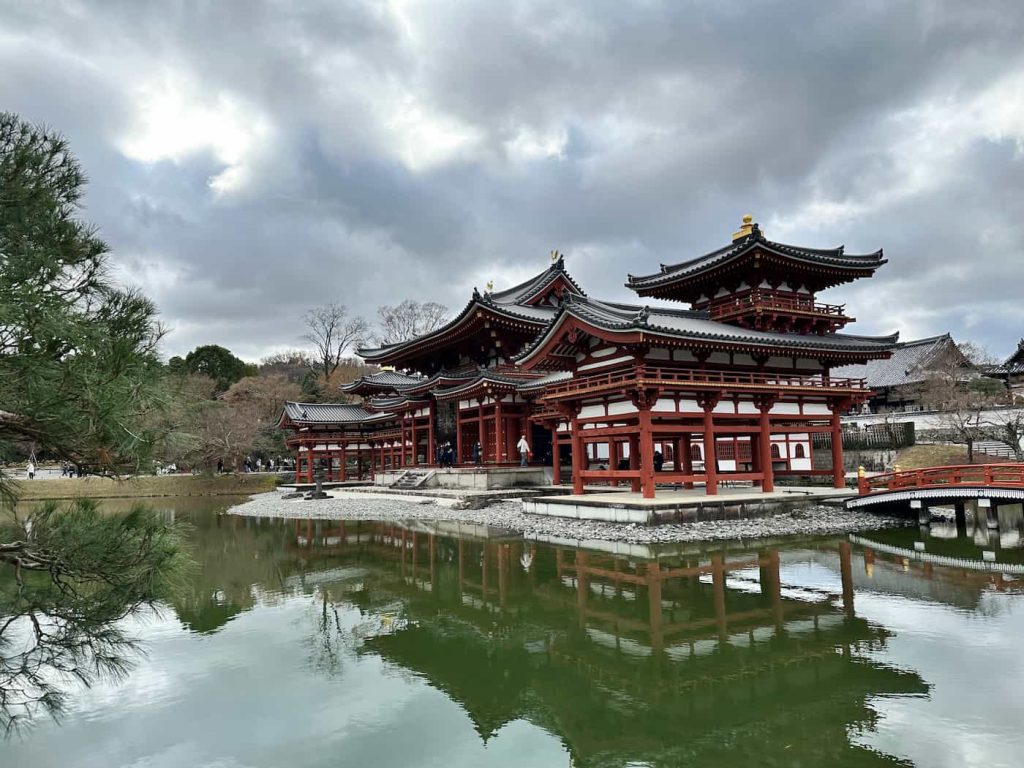
The oldest type of Japanese garden, the paradise garden is a large-scale composition centred on a pond, designed to represent the paradise (Jōdo) of Amida Buddha. The garden at Byōdō-in in Uji is the most perfect surviving example, a great building reflected in still water, with islands, bridges, and plantings arranged to create an earthly image of the Pure Land. These gardens were designed primarily to be seen from a boat, the garden metaphorically representing the world, and the boat the self moving through it.
The Dry Landscape Garden (Karesansui)
Karesansui gardens became popular in Japan in the 14th century thanks to the work of a Buddhist monk, Musō Soseki, who built Zen gardens at the five major monasteries in Kyoto. Yohaku-no-bi, meaning “the beauty of blank space,” is a vital Japanese aesthetic principle underlying this garden style. They are typically enclosed, minimal, and designed to be viewed from a fixed position rather than entered. Their purpose is contemplative; they operate almost as spatial diagrams for meditation.
The karesansui is arguably the most radical spatial invention in the history of garden design. It eliminates water entirely, representing it in raked patterns, and it eliminates the journey through the garden, replacing it with contemplation from a fixed point. It reduces the vocabulary to stones, gravel, and moss, and from these three elements creates compositions of extraordinary spatial and philosophical power. The development of these gardens has strong ties to Zen Buddhism, and they are often seen in temples.
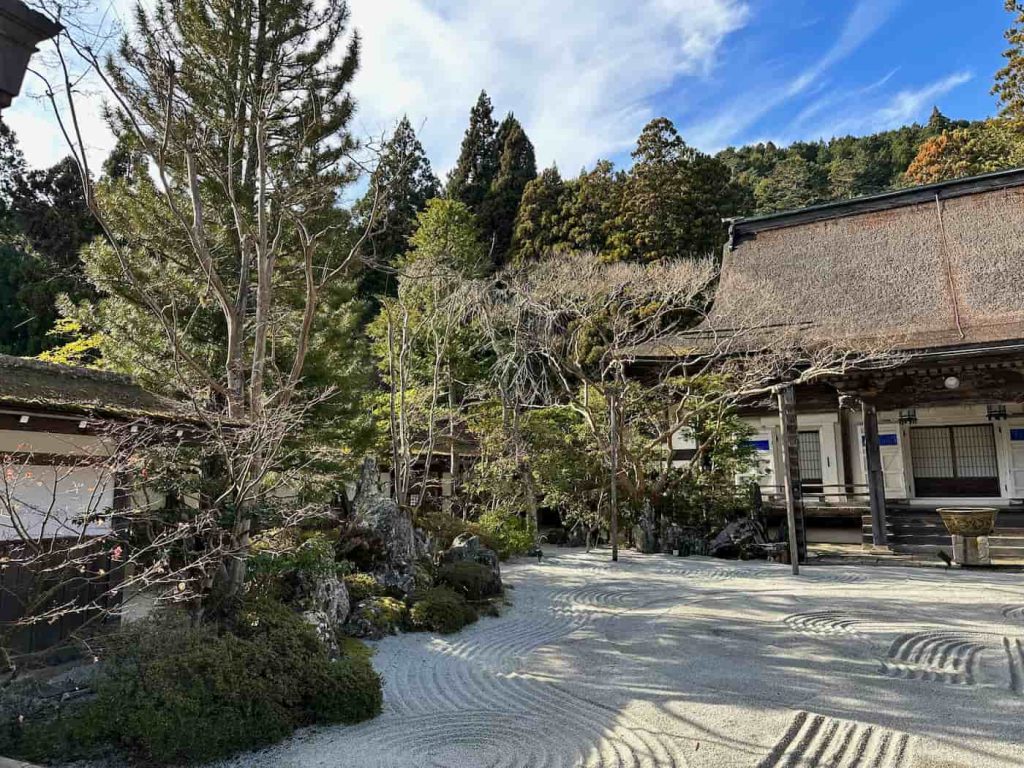
The stones vocabulary is extraordinary. They are chosen for their form, each has a character, an orientation, a social relationship with its neighbours. The stones are classified as “standing stones” (tateiwa), “reclining stones” (fusiishi), and “flat stones” (hirabishi), and are placed in groups typically of odd numbers, three, five, seven. Upright and assertive represent mountains, flat and horizontal represent land masses or sleeping animals, intermediate and placed in asymmetric groupings of odd numbers. The raked gravel patterns called samon are renewed daily by monks, and their forms (concentric ripples around rocks, parallel lines representing the open sea, spiral patterns) are themselves a form of moving meditation.
The Tea Garden (Chaniwa / Roji)
Tea had been introduced to Japan from China by Buddhist monks, who used it as a stimulant to keep awake during long periods of meditation. The first great tea master, Sen no Rikyū (1522–1591), defined in the most minute detail the appearance and rules of the tea house and tea garden, following the principle of wabi: small (the canonical tea room measures four and a half tatami mats), with a low entrance requiring guests to bow as they enter, a gesture that abolishes social hierarchy at the threshold, with natural, irregular, deliberately imperfect materials.
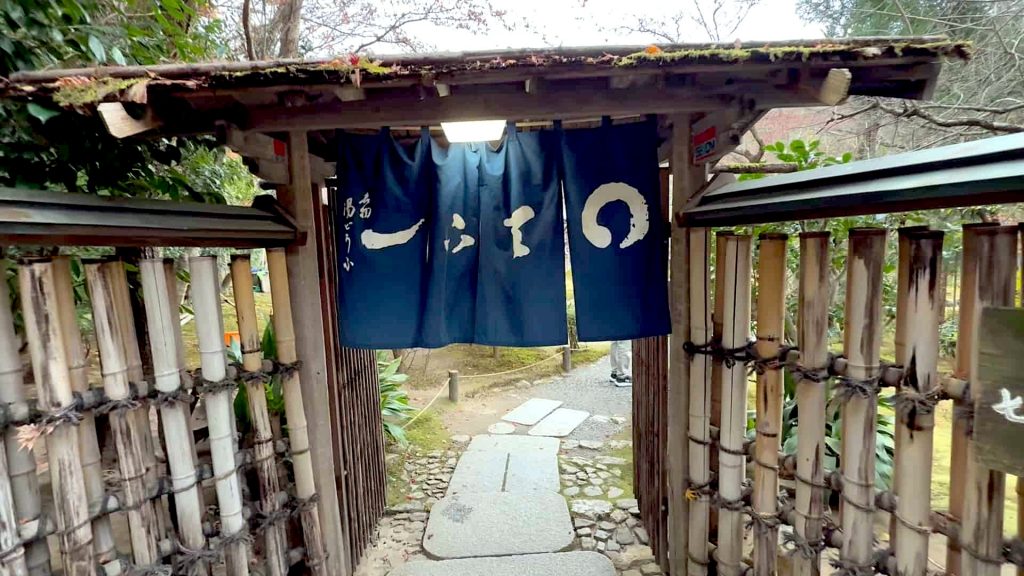
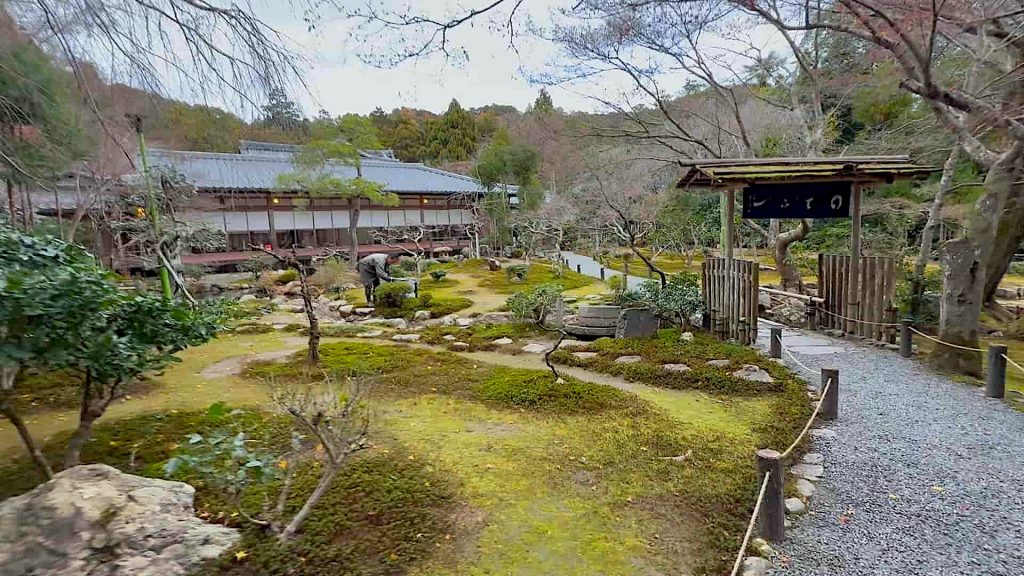
The roji typically begins beyond a gate, proceeds through an outer garden (sotoroji) past a waiting bench (koshikake machiai) where guests wait until summoned, then passes through an inner gate (chūmon) into an inner garden (uchiroji), where a stone water basin (tsukubai) requires the guest to crouch and purify their hands. Its purpose is not aesthetic pleasure, or rather, its aesthetic purpose is entirely instrumental: to prepare the visitor, through a carefully modulated sequence of physical and sensory experiences, for the tea ceremony. The design emphasizes humility, simplicity, and a gradual detachment from the external world.
The Stroll Garden (Tsukiyama, and Chisen-kaiyū-shiki Teien)
Promenade or stroll gardens are more recent, they first appeared in Japan during the Edo period (1600–1854), often associated with aristocratic or feudal estates, and are fundamentally different.These gardens were designed to complement the houses in the new sukiya-zukuri style of architecture and are meant to be explored by walking around a set path, stopping at spots with the best views. These paths are planned so each stop feels like its own scene.
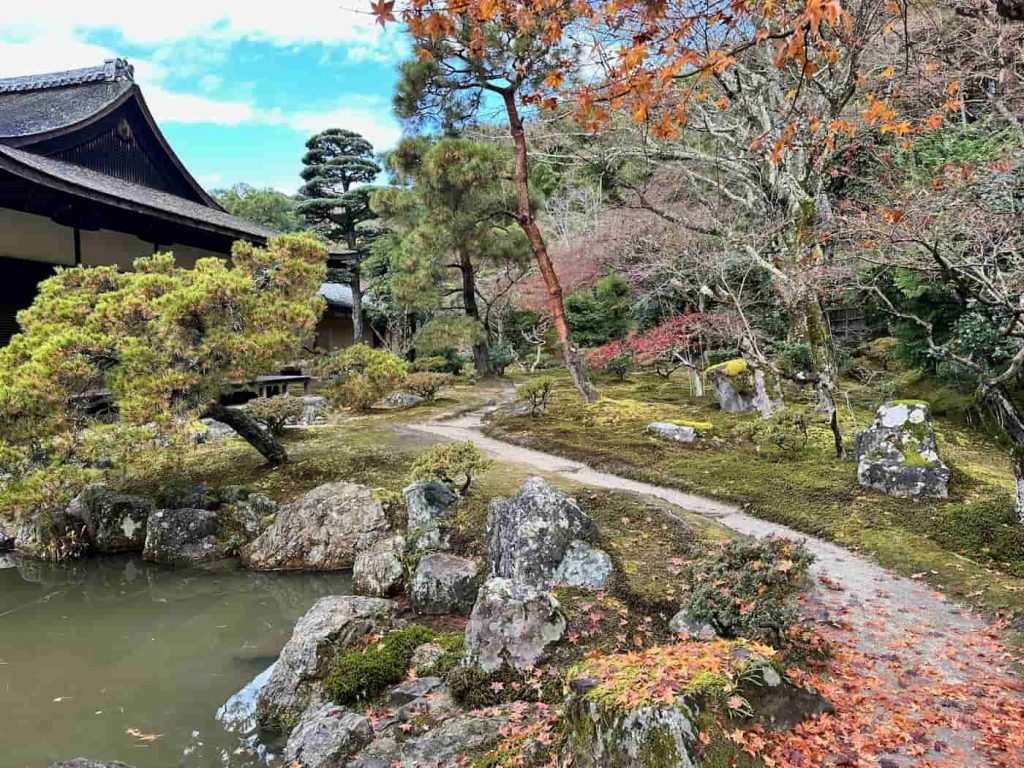
The stroll garden is the most spatially complex of all Japanese garden types, because it is explicitly designed as a temporal sequence, a journey through a series of scenes, each complete in itself but gaining meaning from what precedes and follows it. What tsukiyama and chisen-kaiyū share is the assumption that the viewer moves. Kōraku-en in Okayama These gardens incorporate artificial hills (tsukiyama) for elevation change and varied prospect; ponds with islands, bridges, and boats; teahouses at the best viewpoints each with its own character and name.
House Gardens
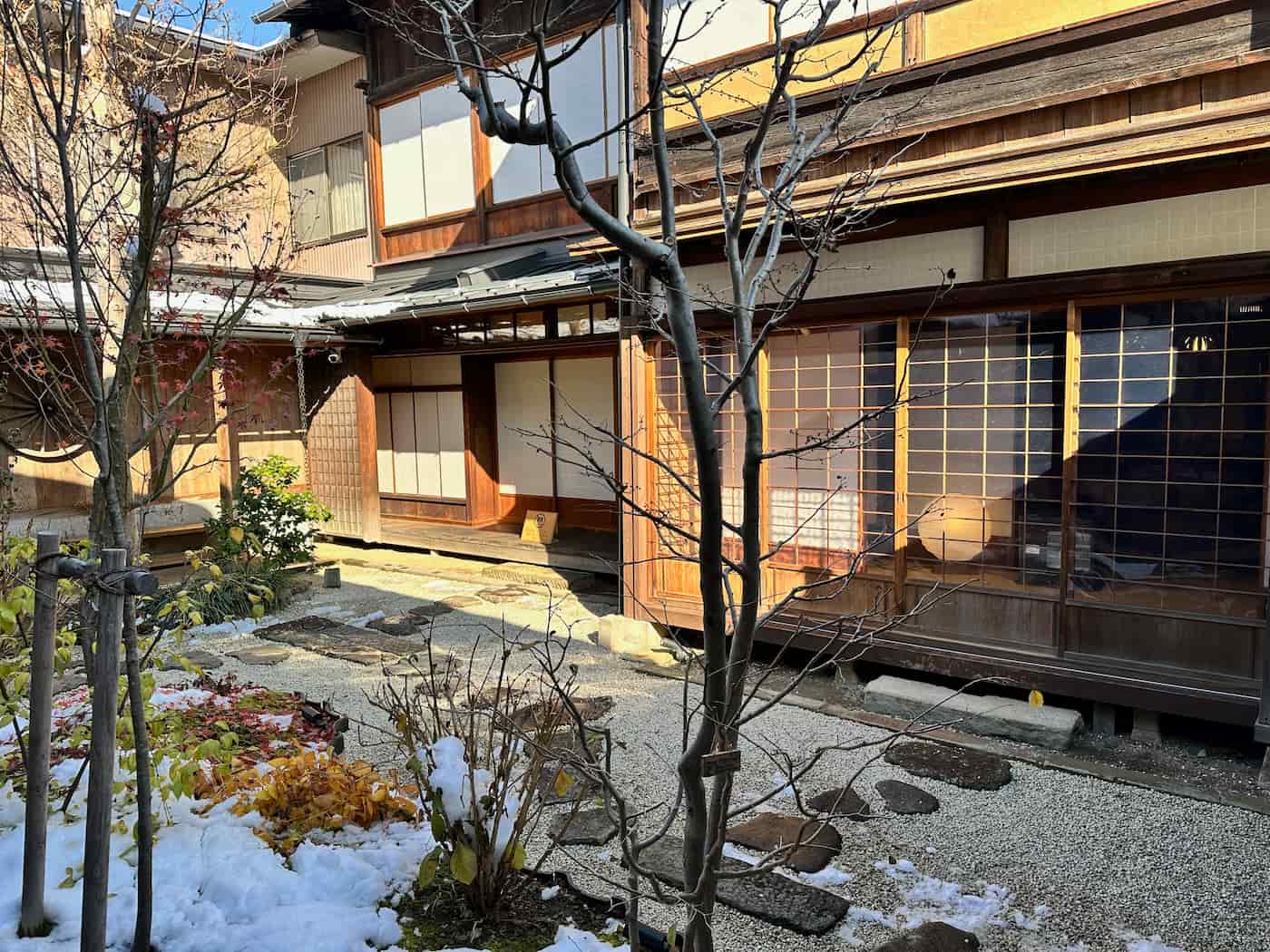
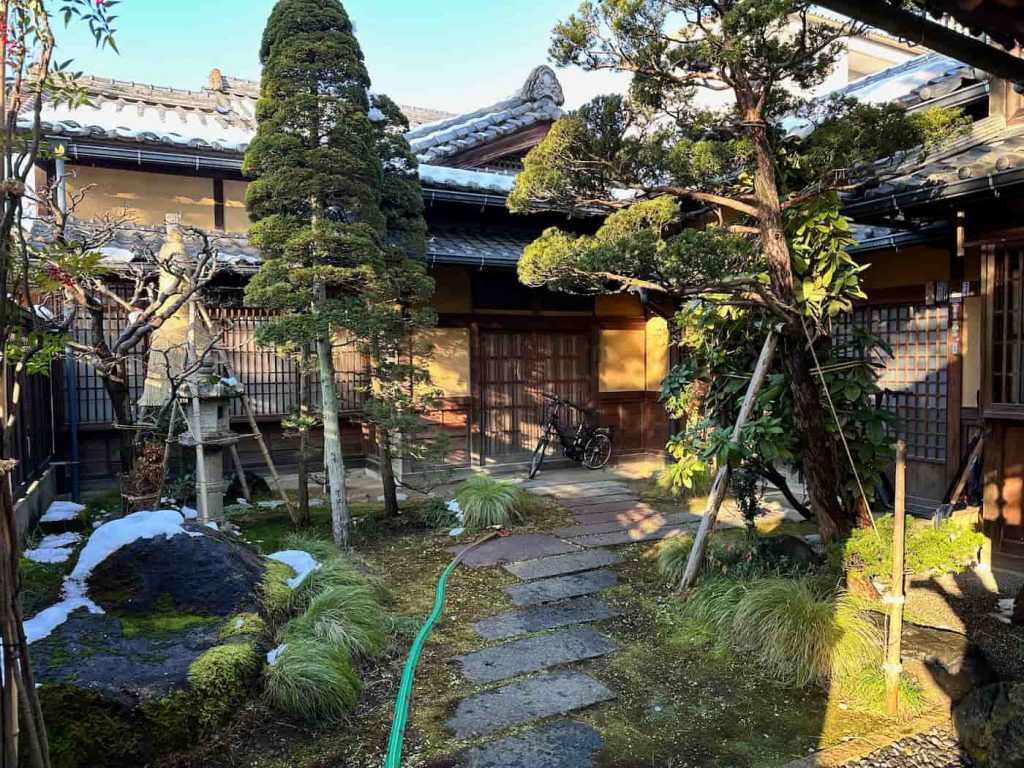
Attached to traditional residences, operate at a more intimate scale. They are often viewed from the interior, particularly from the engawa, and are composed to align with specific sightlines. Here, the garden becomes an extension of the domestic space, reinforcing the fluid boundary between inside and outside.
Castle Gardens
The great daimyō castle complexes of the Edo period (Edo Castle in Tokyo, Nijō Castle in Kyoto, Nagoya Castle, Himeji Castle) incorporated both functional defensive landscapes and ornamental gardens. While they employ the same vocabulary, stone, water, vegetation, the scale and visibility are amplified, turning the garden into a political as well as aesthetic statement.
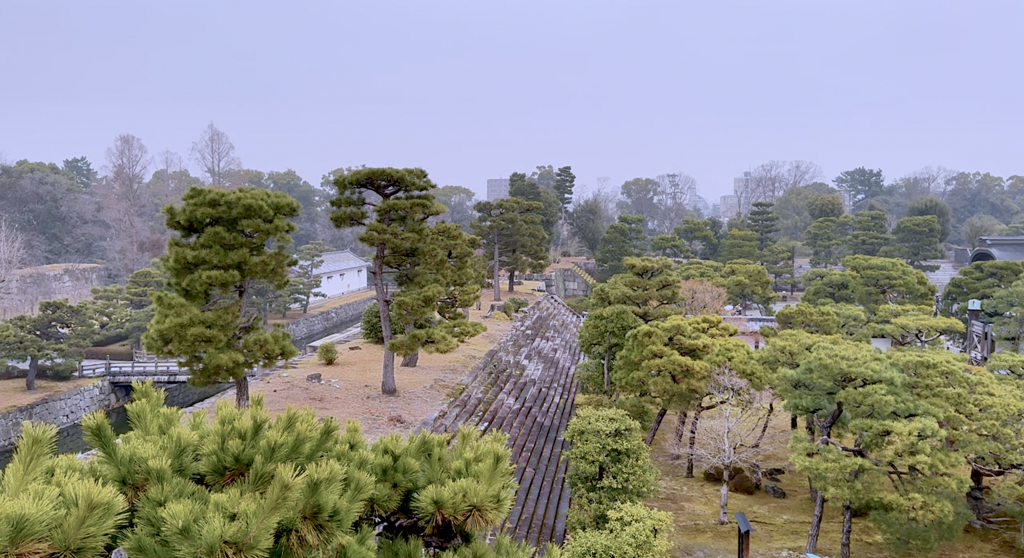
The Ninomaru Garden at Nijō Castle, attributed to the garden designer Kobori Enshū, is a superb example of early Edo period garden design: a central pond with three islands, connected by arched stone bridges, surrounded by carefully shaped stones and plantings, all designed to be viewed from the main reception hall as a demonstration of political and aesthetic power.
Key plant choices and materials
Japanese garden design was practiced by a remarkable range of figures: Buddhist monks, particularly Zen monks, who designed many of the great karesansui gardens, daimyō lords who sometimes designed their own stroll gardens, professional garden designers and anonymous craftsmen working within established typological traditions.
The plants palette tends toward evergreen species that provide year-round structure, with seasonal accent plants providing moments of drama. Pine is the single most important plant in the Japanese garden tradition. The Japanese black pine (Kuromatsu) and Japanese red pine (Akamatsu) are pruned and trained over decades into complex, pictorial forms, their twisted branches trained toward the light, their crown silhouettes refined to capture the quality of a weatherbeaten coastal tree.
Other essential plants include bamboo used for screening, structure, and sound, moss covers the ground beneath trees and around stones representing age and moisture and the softness of time, Japanese maple (momiji) for its brilliant autumn colour, cherry (sakura), the spring blossom, symbol of the transience of beauty, and water iris for the purple midsummer display at the edge of ponds.
Maintenance is as important as design in the Japanese garden tradition, and in some ways it is the more accurate ongoing creative act. A garden changes over decades: as trees grow and die, moss spreads, stones settle, and the designer’s intentions evolve through the hands of successive gardeners (niwa-shi). The daily raking of the karesansui gravel, the seasonal pruning of the pines, the precise control of moss growth are ongoing acts of design, not mere maintenance.